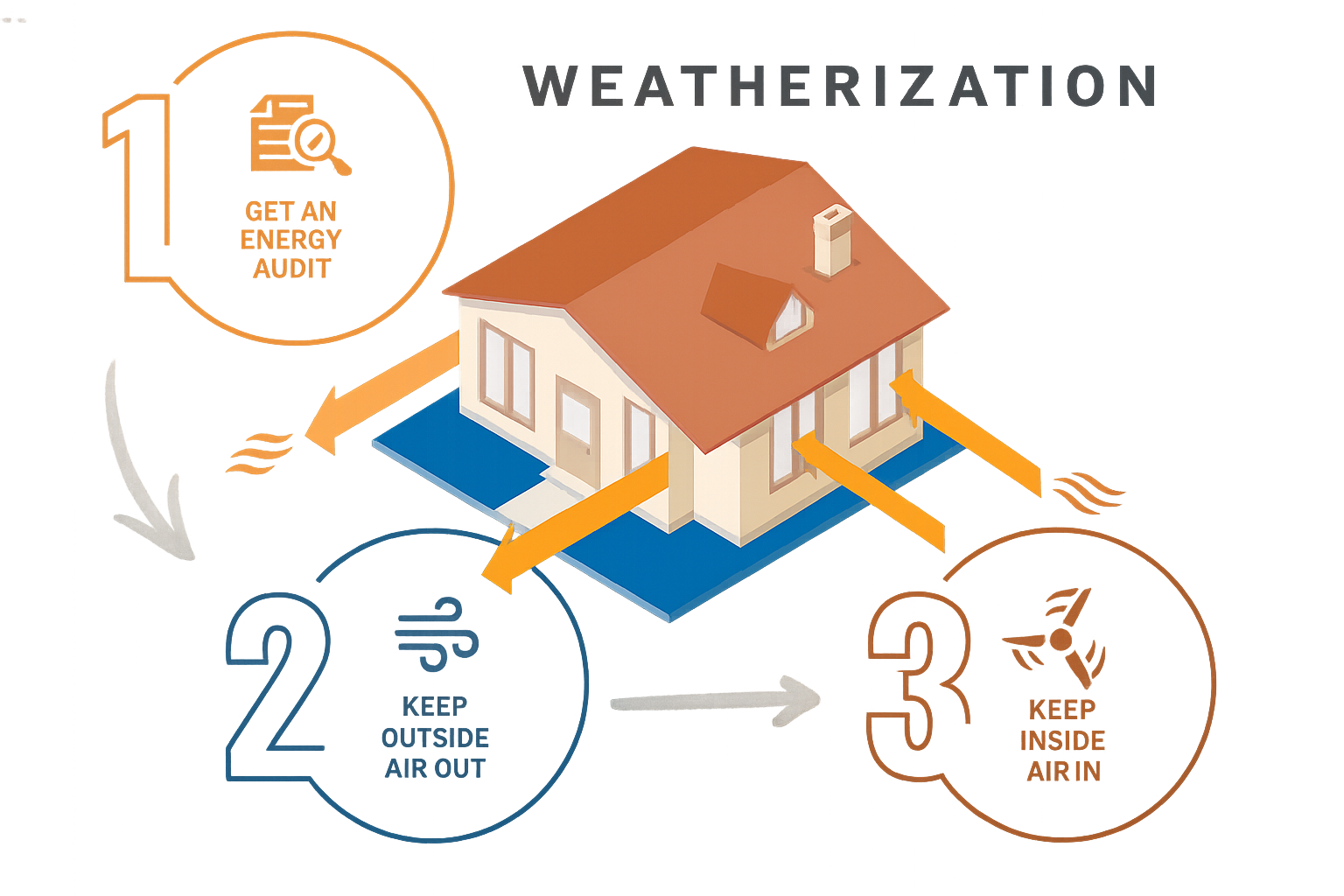
What is weatherization and why do it?
Weatherization is any improvement aimed at sealing or insulating a home to maximize its energy efficiency and comfort. Heat leaks through the home’s outer walls, windows, doors, and other openings.
Why spend money heating or cooling the outdoors? Keep outside air out and inside air in with weatherization. You can start small with these DIY hacks and go deeper as time and budget allow.
Find options that fit you
Find choices that are right for you based on these icons:
Filter the options
Pick any combination to see only the steps that fit.
0: Does your household income make you eligible for FREE state programs?


 You may be eligible for free upgrades through one of PSE&G’s incentive programs.
0a. Home Weatherization: This state-regulated program run through PSE&G provides an energy assessment, a smart thermostat, sealing and insulation upgrades, energy-efficient HVAC system installation, and more all at no cost to you. Read full program info and sign up here.
0b. Comfort Partners: This state-regulated, state-run program provides an energy assessment, a smart thermostat, sealing and insulation upgrades, energy-efficient HVAC system installation, and more all at no cost to you. Read full program info and sign up here.
Income Eligibility Tiers: Check the income-eligibility range based on the number of people living in your household.
| Number of People in Household | Annual Household Income for “Comfort Partners” Program | Annual Household Income for “Home Weatherization” Program |
|---|---|---|
| 1 | $0–$39,900 | $39,901–$63,840 |
| 2 | $0–$54,100 | $54,101–$86,560 |
| 3 | $0–$68,300 | $68,301–$109,280 |
| 4 | $0–$82,500 | $82,501–$132,000 |
| 5 | $0–$96,700 | $96,701–$154,720 |
| 6 | $0–$110,900 | $110,901–$177,440 |
| 7 | $0–$125,100 | $125,101–$200,160 |
| 8 | $0–$139,300 | $139,301–$222,880 |
If you are a renter, you are still eligible! The program will work with you to obtain your landlord’s permission. All upgrades will be provided at no cost to your landlord.
1: Find your leaks
1a. 
 Identify where heat is escaping from your house: through cracks around windows, doors, and electrical outlets. While this one has no direct impact on your bills or comfort levels, it’s an important first step to finding the areas where further actions can have significant impact!
1b. 
 Want a more comprehensive assessment? Get a professional Home Energy Audit from PSEG to identify opportunity areas for weatherization. Professionals have special equipment that can measure how much heat is escaping your home and specifically where that is occurring.
While an assessment in and of itself has no direct impact on bills or comfort levels, this has a very large impact on evaluating the high-impact actions for which you can hire a professional.
2: Seal your doors
2a. 
 Gaps between the door and frame are a common source of drafts. Add weather stripping around doors to create a tighter seal.
3: Seal drafty windows
3a. Got $5 and a hairdryer? Seal drafty windows with plastic film for the season.
3b. Want a better seal? Caulk gaps near the window frame. You can use a standard caulk gun or use “rope caulk” if that’s easier for you.
3c.  Consider upgrading your blinds. According to the U.S. Department of Energy, snugly fitting honeycomb blinds can reduce a window’s winter heat loss by 40%, translating into overall household energy savings of about 10%. In summer, snuggly-fitting cellular shades can reduce solar heat gain by up to 20%. Alternatively, you can use thermal curtains, but their impact is less significant.
3d.  Want to do major upgrades? Consider replacing old, leaky windows with double pane, better insulating windows. According to the U.S. Department of Energy, heat gain and heat loss through windows account for up to 30% of residential heating and cooling energy usage.
It’s important to consider windows with performance labels like ENERGY STAR® and National Fenestration Rating Council (NFRC)ratings like U-Factor, Air Leakage, and Solar Heat Gain Coefficient (SHGC). The NFRC describes how to read their label ratings, and ENERGY STAR website offers full purchase guidlines.
4: Seal electrical outlets
4a. A simple, $2 fix stops one of the most overlooked sources of leaks – electrical outlets on exterior walls.
5: Check your HVAC filters
5a. Clean air duct filters help your ducted HVAC system run efficiently. Typically, the best practice is to replace it monthly.
6: Insulate
6a. Seal and insulate your easy to reach spaces in your attic yourself. This can include sealing gaps, laying down fiberglass batt insulation, weatherstripping around your attic hatch, and adding a movable cover over the entrance to your attic. If you attempt this, make sure to wear proper protective gear, especially an N95 respirator mask, gloves, and safety goggles!
6b. In your basement, you’ll want to inspect the walls for cracks, and the area where the frame of your home meets the basement walls (called the “rim joists”) for drafts. Rim joists and walls can be insulated with rigid foam or spray foam.
6c. Hire a contractor to insulate your walls and attic. This process starts with hiring a contractor to conduct a Home Energy Audit to determine the scope of your professional weatherization project. With state incentives through PSE&G, you can get up to $7,000 in discounts and 0% interest financing with on-bill repayment between $25,000 and $75,000. View full program information from PSE&G here.
Again, income-eligible households can get all this done for free! See section 0 above.
7: Use the sun
7a. During the winter, adjust your double honeycomb shades or curtains to let in sun during the day and close them at night. In the summer, reverse!
7b. Install plug-in solar panels and get free electricity to offset your energy costs. This one’s coming in March, so stay tuned!
7c. Sign up for community solar. Solar developers are required by the state of New Jersey to share solar credits from this program with consumers. See Electrify SOMA’s Community Solar page for more information about how this works and how to sign up.
Note: Signing up for community solar SHOULD be easy, but as of November 2026 there is a waitlist for most projects. This waitlist should clear up in 2027 as a new wave of projects comes online.
7d. A rooftop solar lease or “Power Purchase Agreement” (PPA) requires no up front costs and the company is responnsible for all panel maintenance. This is the best option if you have tight cash flow. With a lease, you pay a flat monthly fee for the power your panels produce. With a PPA, you pay for the power at a monthly rate. Do watch out for a rate escalator in the contract! See Electrify SOMA’s Rooftop Solar page for pros and cons of this approach and full details on how to complete this project.
7e. Purchasing solar panels outright gives you the best long-term value because you pay $0 for your electricity usage from Day 1 (as longs you have enough roof space to install enough panels to cover 100% of your electricity usage). See Electrify SOMA’s Rooftop Solar page for pros and cons of this approach and full details on how to complete this project.
8: Warm only the areas you need
8a. During the winter, use the “reverse” switch on your fans to push warm air down to you.
8b. Heat yourself rather than the room with heated vests and/or electric blankets.
8c. Got one cold room? Instead of cranking up the temperature for the whole house, add a free-standing heat pump to that room.
8d.  If you have windows that slide up and down and are at least 26” wide, you can install window unit heat pumps that can control the temperature of each room individually. See Electrify SOMA’s Heat Pump HVAC page for thorough information.
8e. Install whole house heat pumps that adjust the temperature individually in each room and help transition off fossil fuels. See Electrify SOMA’s Heat Pump HVAC page for thorough information.
9: Bonus Money Saving Hacks
9a. Consider signing up for PSE&G’s Time-of-Use (TOU) electricity rate billing. With TOU rates, you can save money by shifting your electricity usage to off-peak hours. This is especially impactful if you own an EV you can set to charge after midnight.
PSE&G offers a tool that analyzes your electricity usage history to determine if you can save money with the TOU rate. You can access that tool and enroll if you want here.
9b. Line dry clothing instead of using the dryer.