
Now, anyone can purchase solar energy without the need for expensive installations on your home! If you’re a renter, condo-dweller, or own a home with a shaded roof, NJ’s Community Solar program was tailor-made for you. That said, even single-family home owners can join in, as long as you don’t have solar panels already installed on your roof.
Community Solar customers can “subscribe” to a portion of a commercial solar installation and receive a credit on their electricity bill for the electricity generated by their share of the generation. The subscription is guaranteed to reduce your considerably cheaper than regular utility bills, and can be cancelled anytime. If the subscribed portion of the solar project produces more energy than you use, PSE&G will automatically bank the excess power for you to use in less sunny months.
Actions you can take right now:
- Find a project near you on the New Jersey Solar Project Finder.
- Determine if you qualify as a low-to-moderate income (LMI) subscriber, which can earn you better rates.
- Read our step-by-step guide on how to sign-up below!
How does this work? How much will it cost me?
We have good news for you: it won’t cost you a penny out of pocket. We know that sounds too good to be true, but we hope you’ll take the word of your neighbors who have already signed up! Here’s exactly how that works:
Community solar projects are affordable for many reasons, including, but not limited to:
- They don’t have to purchase fuel the way fossil fuel plants do. The sun is always free!
- Once built, the panel arrays have very low maintenance costs, especially when compared to complicated fossil fuel plant infrastructure.
- Community solar projects receive government subsidies to help move our transition to renewable energy forward.
Because of this, community solar developers quickly recoup their construction costs by selling power back to the grid. Here’s how that works out for you:
- When you subscribe, they analyze your last year’s worth of PSE&G electricity consumption and use that to allot an equivalent portion of solar power generation from the project to you. This is typically 80-90% of your monthly usage.
- Every month, PSE&G calculates how many kWh of power you used, as usual.
- Meanwhile, your subscribed portion of the solar array produces a certain amount of kWh that month.
- That number shows up on your PSE&G bill so that they can calculate its worth. For simplicity’s sake, let’s say one month’s solar production share worth is $10. PSE&G distributes the $10 credit to you and the Community Solar provider.
- Your community solar provider receives a contractual portion of that credit — in this example, 25%.
- This transaction takes place on your monthly bill, with a net $2.50 credit applied to you after the Community Solar provider’s share and no out of pocket cost to you.
Plus, you’re helping support the transition to clean energy by showing there is demand for it!
Real SOMA Community Solar Example
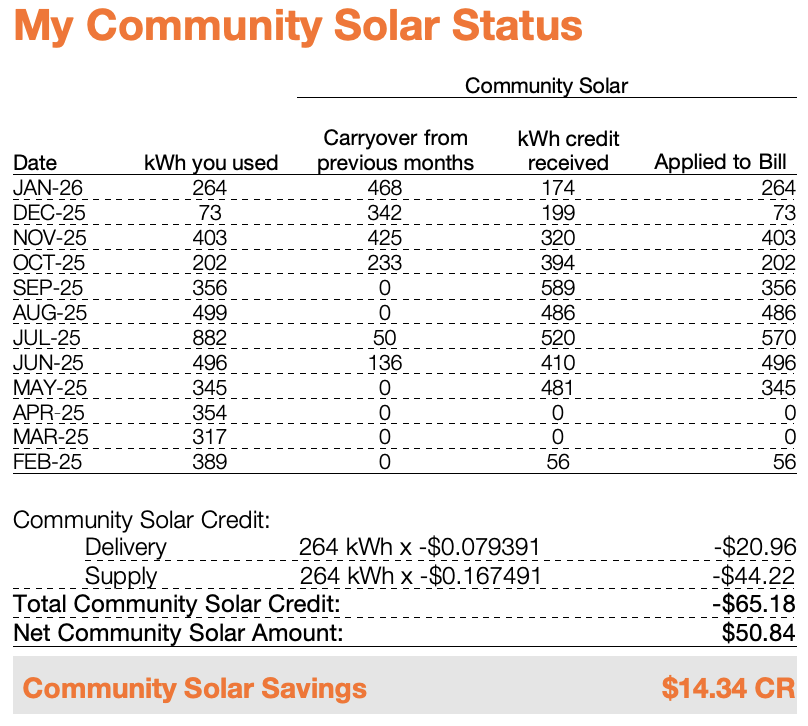
Here’s an example of a real SOMA resident’s community solar savings. (Note: The first month shown was a connection test before the subscription went into effect in May 2025.)
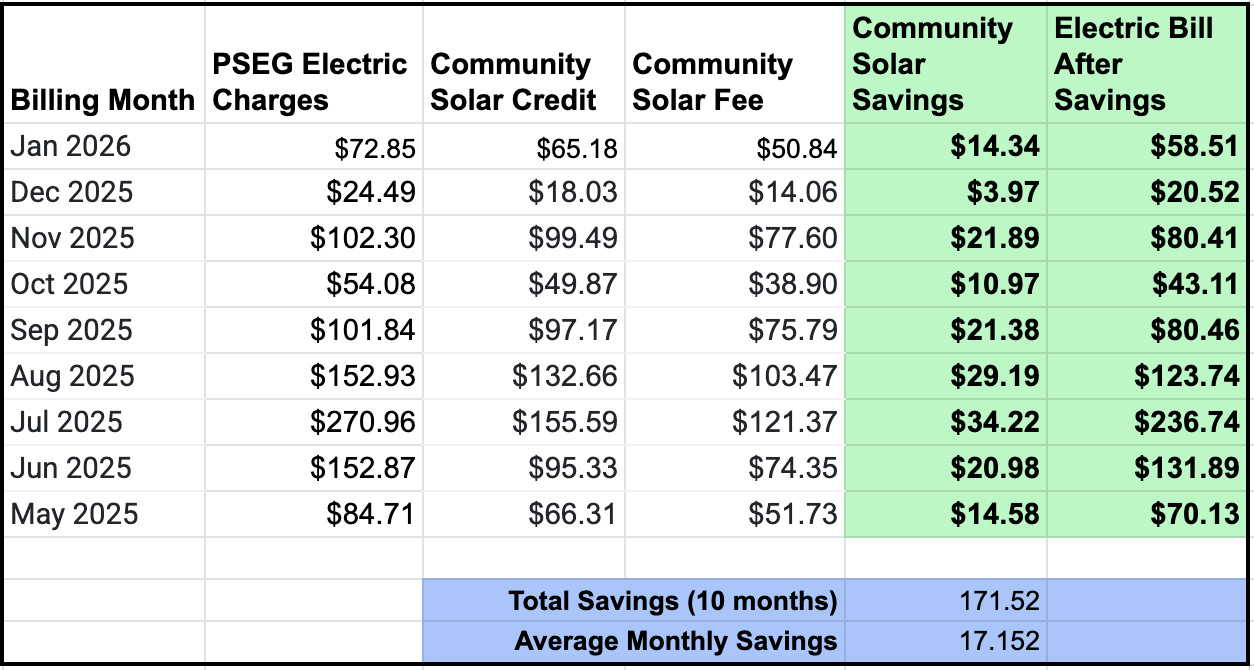
And here are that same SOMA resident’s savings from May 2025 through January 2026. Saving $171.52 over 9 months might not be life-changing for everyone, but it’s a win-win for you and the environment.
How can solar reduce emissions?
Solar panels convert sunlight into electricity without emitting carbon dioxide or other greenhouse gases. Electricity generated by the sun replaces electricity generated from sources such as natural gas, curtailing your home’s emissions. Since the community solar subscriptions fund the development of solar projects, it’s an excellent way to encourage and help finance solar power production.
Step-by-Step Sign-Up Guide
A MORE THOROUGH GUIDE IS IN THE WORKS!
1. Determine if you qualify as a low-to-moderate income (LMI) subscriber in your home zip code.
NJ reserves a portion of slots in every community solar program for LMI applicants. As such, LMI applicants get priority sign-up and, in some cases, even higher savings percentages in their contracts.
| Household Occupancy | Household Income Limit |
|---|---|
| 1 Person | $72,950 |
| 2 Person | $83,400 |
| 3 Person | $93,800 |
| 4 Person | $104,200 |
| 5 Person | $112,550 |
| 6 Person | $120,900 |
| 7 Person | $129,250 |
| 8 Person | $137,550 |
If your household falls into one of these categories defined by the state for Essex County, then you qualify as an LMI subscriber. When you sign up for a community solar project, you simply need to fill out this form.
2. Gather your PSE&G bill and usage data.
When you apply, you need to give the company a copy of at least one PSE&G bill and the last 12 months of electricity usage data. You can download the usage data from your online PSE&G account or simply send them copies of your last 12 bills.
3. Prepare to comparison-shop.
Community Solar is a government program; however, private companies sell the subscriptions (not PSE&G). Therefore, the process involves comparison shopping from different Community Solar companies. Grab a notepad and prepare to list the differences between providers.
4. Review lists of providers.
The New Jersey Solar Project Finder and PSEG offer lists with key information to consider.
5. Consider the savings each provider offers.
Community Solar providers will charge less than the credit you receive from the utility for generating solar energy. This percentage savings is key when comparison shopping. It is typically between 10% and 45%, and can be more if you are income-qualified.
6. Contact the providers directly.
In many cases, contacting the providers directly will get you the best price. These providers are private companies looking to sell subscriptions, so they are motivated to deliver competitive savings.
7. Consider other requirements and terms.
Just like any subscription, there may be contract terms to consider. Some providers do not require long-term contracts and do not impose additional fees. However, some may not guarantee their
8. Reach out to Electrify SOMA with any questions!
We’re happy to help you navigate the process.